New Model Report: GPT-6 Sol and Luna, Claude Opus 5.5, and Grok 4.7


Several major AI models have arrived almost at once. Grok 4.7 is aimed at coding and longer tasks. Claude Opus 5.5 promises stronger results at a lower cost than its predecessor. GPT-6 Sol and Luna bring less expensive options to OpenAI's GPT-6 family. Each launch makes a case for its own model. I put the available results together so we can compare them on the same kinds of work.
How I put the charts together
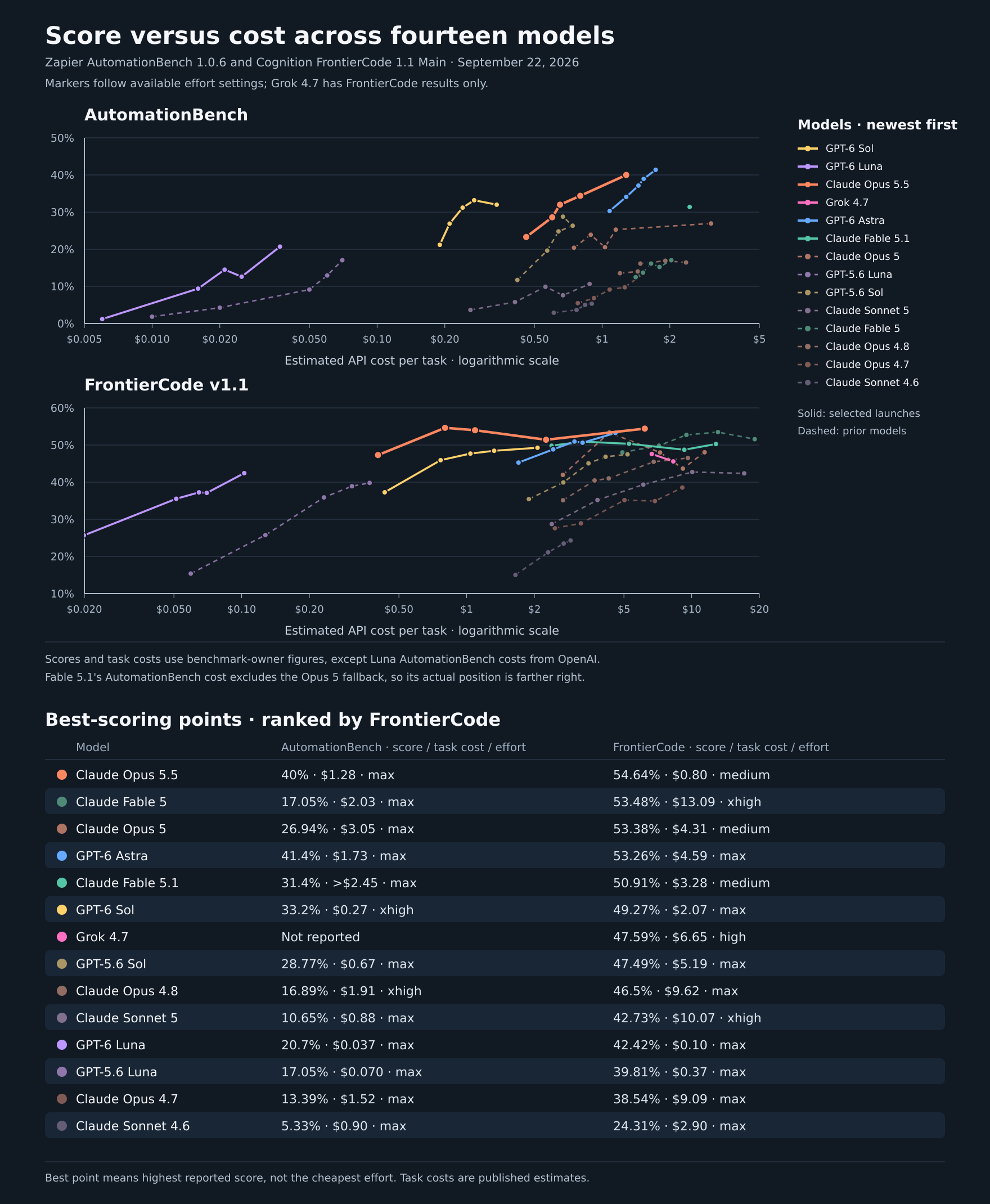
Zapier's AutomationBench tests whether an AI model can finish business tasks across apps, such as updating the right record and sending the right message. Cognition's FrontierCode tests whether AI-written code is good enough to be accepted into a software project. For this September 22 snapshot, I used the scores and estimated cost per task published by those benchmark owners, except for GPT-6 Luna's more precise business-task costs from OpenAI. These are compiled results, not tests I ran myself.
Each connected point represents an effort setting, which controls how much computing the model can use on a task. The table shows each model's highest reported score on each test, along with the cost and effort at that point. Solid lines highlight recent models; dashed lines provide earlier comparisons. A higher point means more test tasks completed, while a point farther left has a lower estimated AI-service cost. Read the two panels separately: success in a business workflow is different from success in a coding task.
Tap, hover, or focus a point for details. Zoom with the controls, wheel, or pinch; drag a zoomed chart to pan.
AutomationBench
FrontierCode v1.1
| AutomationBench | FrontierCode | |||||
|---|---|---|---|---|---|---|
| Effort | Effort | |||||
| Claude Opus 5.5 | 40% | $1.28 | max | 54.64% | $0.80 | medium |
| Claude Fable 5 | 17.05% | $2.03 | max | 53.48% | $13.09 | xhigh |
| Claude Opus 5 | 26.94% | $3.05 | max | 53.38% | $4.31 | medium |
| GPT-6 Astra | 41.4% | $1.73 | max | 53.26% | $4.59 | max |
| Claude Fable 5.1 | 31.4% | >$2.45 | max | 50.91% | $3.28 | medium |
| GPT-6 Sol | 33.2% | $0.27 | xhigh | 49.27% | $2.07 | max |
| Grok 4.7 | Not reported | — | — | 47.59% | $6.65 | high |
| GPT-5.6 Sol | 28.77% | $0.67 | max | 47.49% | $5.19 | max |
| Claude Opus 4.8 | 16.89% | $1.91 | xhigh | 46.5% | $9.62 | max |
| Claude Sonnet 5 | 10.65% | $0.88 | max | 42.73% | $10.07 | xhigh |
| GPT-6 Luna | 20.7% | $0.037 | max | 42.42% | $0.10 | max |
| GPT-5.6 Luna | 17.05% | $0.070 | max | 39.81% | $0.37 | max |
| Claude Opus 4.7 | 13.39% | $1.52 | max | 38.54% | $9.09 | max |
| Claude Sonnet 4.6 | 5.33% | $0.90 | max | 24.31% | $2.90 | max |
Choosing a model from the results
For coding, FrontierCode makes me lean toward Claude Opus 5.5 at medium effort. For business workflows, AutomationBench makes GPT-6 Luna and Sol look like better value than Opus 5.5 through its high effort setting. At the highest end, GPT-6 Astra and Opus 5.5 are close. Grok 4.7 has no business-workflow result here, so I can't judge it on that test.
Zapier tested Fable 5.1 with Opus 5 as a backup. Opus stepped in when Fable refused a step, so the business result includes Opus's help. The chart's cost leaves that help out, meaning the full setup would cost more.
These are starting points, not a verdict. Models can count the same text as different numbers of tokens, and some tasks need much longer answers than others. The model that costs least in this benchmark may cost more on your work. Paying more or choosing a higher effort setting does not guarantee better results. Try two candidates on the same real tasks and compare what they finish, what you pay, and how much you have to fix.
A different kind of efficiency: Jev
TypeSafe opened Jev to everyone on September 20, after a September 15 early-access introduction. Jev makes small decisions inside software rather than writing code or prose. Give it a defined set of answers and it returns a choice, score, or yes/no result with a confidence estimate. TypeSafe reports responses in a fraction of a second and prices input at 4.2 cents per million tokens.
In a coding agent, Jev could choose which model to call, check whether a tool result fits a request, or decide when to ask a larger model to review something. An independent test used Jev's confidence estimates to send uncertain cases to a larger model. On those tested decisions, the combination matched the larger model's accuracy while using fewer expensive calls. The larger model would still write the code and handle open-ended reasoning.